 The
Science Notebook
The
Science NotebookExploring Measurement - Length
The
Science NotebookHome Terms of Use Safety Contact Us Experiment Pages Downloads Supplies Useful Links!
How tall are you? How long is a football
field? How far is it to your school? How far is
the earth from the sun? How big is that little
paramecium you saw under the microscope in science
class? All of these questions ask how long
something is, but the answer in each case is very
different. If you live in the United States, you
probably measure your height in feet and inches, the length
of the football field in yards, the distance to your school
in miles, the distance from the earth to the sun in millions
of miles, and the size of that paramecium in thousandths of
an inch. But, did you ever wonder where all those
units - inches, feet, yards, and miles - came from?
Let’s find out.
Materials Needed:
Ruler;
yardstick, or tape measure; several volunteer friends.
Procedure:
For each volunteer, measure and record the following in
inches: the length of the nose from the forehead to the
tip; the length of the bottom of the foot; and the distance
from the tip of the nose to the end of the index fingertip of
an outstretched arm. Put the measurements in a table like
this:
| Name | Nose (in) | Foot (in) | Nose to Fingertip (in) |
| Joe C. | 1 ¾ | 10 ½ | 33 |
| Donita Z. | 1 ½ | 9 | 28 |
What
To Look For: Did you measure any nose that was
exactly one inch? Any foot that was exactly 12
inches? How about any nose tip to finger tip that was
exactly 36 inches?
What Happened: No one
knows for sure how feet, inches or yards came about, but many
believe that they came from the lengths of various body
parts. One theory says that these lengths were set
by the length of these body parts of the king or queen in
power at the time. Thus, the length of the royal nose
became the standard for one inch, the length of the royal foot
became the standard for one foot, and the distance from the
tip of the royal nose to the tip of the royal index finger
became the standard for one yard. As you can see from
your measurements above, the length of each of these could
vary greatly depending on who was king or queen at the
time. People apparently got tired of changing these
lengths each time a new king or queen came along, and at some
point, the lengths for each of these units became standard
throughout the British Empire.
Going Further: There
are many different units of length in the English system of
measurement. Look at a table of English weights and
measures in a math book, almanac, dictionary or
encyclopedia. Some will be very familiar, some you may
have heard of but may not be familiar with, and some you’ve
probably never heard of at all. How would you like to
have to keep up with all of them?
Materials
Needed: A good pair of walking shoes; a watch; a safe
place to walk a mile.
Procedure: Find a
location such as a school track that has a measured
mile. Time how long it takes you to walk one mile and
record the time.
Using that time, figure out how long it would take you to walk
the following distances:
| Across the United States | 2,500 miles |
| From the Earth to the Moon | 250,000 miles |
| From the Earth to the Sun | 93,000,000 miles |
You may need to get an older
student, adult or teacher to help you do the math, since you
will have to convert minutes to hours, days, and even years.
What To Look For: A
very slow mile will take about fifteen minutes to walk.
You will probably do it in much shorter time.
What Happened:
Assuming a 15 minute mile, it would take you the following
times (approximately) to walk the above distances:
| Across the United States | 2,500 miles | 26 days* |
| From the Earth to the Moon | 250,000 miles | 7.1 years* |
| From the Earth to the Sun | 93,000,000 miles | 2654 years* |
*This is walking nonstop for
twenty four hours a day - no time to eat or sleep!
One mile is equal to 5,280 feet. Here’s how that
distance came about. English measurement for a length of
land was a unit called the rod, which was an old Saxon unit. A
rod equals 5.5 yards (16.5 feet). 40 rods equals
one furlong, which was traditionally the length of a row on
old English farms. In 1592, the length of a mile was set at 8
furlongs, which works out to 1760 yards or 5280 feet.
Confusing, isn’t it?
The English system of measurement served its
purpose, and in many respects, is still a useful system
today. Those of us who live in the United States
eventually learn the most common conversions for most of the
everyday measurements - inches, feet, yards and miles. In
fact, because this is the system man of us first learned, it
seems very natural to use these units. However, most
of us never bother with rods, furlongs, fathoms, leagues or
other English units used to measure length simply because we
don’t need them.
But the problem with the
English system is that there are so many different units,
and these units can get confusing after a while. Also,
if you have to convert even lengths you are familiar with -
say, inches to yards - you have to remember conversion
factors from one unit to another, and there are several to
remember. Also, many of the conversions don’t seem to
be related to one another at all.
In the 1790's, the French
decided to do something about this. They developed a
system of measurement called the Metric System. The
units in the metric system are much simpler to work with
because there is only one basic unit for each quantity being
measured. To measure length, all of the English units you
have looked at have been replaced by just one unit - the
meter. Let’s look closely at a meter, and we’ll see why it
is such a good unit to measure things.
Materials Needed: Meter
stick;
yard stick.
Procedure:
You can probably borrow a meter stick from your school.
Place the meter stick beside the yard stick. Which is
longer? By about how many inches? (By the way,
some yard sticks also have metric divisions on the reverse
side, and some meter sticks inches on the reverse. Does
yours?)
What To Look For: You
will notice that the meter is just a bit longer than the yard,
a little over three inches, in fact. This is the basic
unit of measurement in the metric system for length. And as we
will see elsewhere in the Measurement pages, the meter is also
used to define the basic units of weight and volume.
The length of the meter was originally based on the distance
from the North Pole to the equator, or one quarter of the
distance around the earth. The meter was defined as -
are you ready for this? - one ten millionth of that distance!
Today, the length is defined very differently, but the actual
length of the meter is still the same.
Anything that can be measured in yards can also easily be
measured in meters, since the two lengths are about the
same. You only need to remember that a meter is a little
longer than a yard.
Going Further:
But
what about things that can’t be easily measured in
yards? Can we use the meter to measure things we usually
measure in inches, feet or miles? As it turns out, we
can, and we can do it without having to do all those
conversions that are required in the English system!
CAUTION!
Always use sharp objects such as knives or scissors with
adult supervision only! Hold any sharp point away from
your body, particularly your eyes.
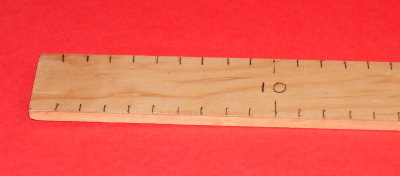
In this experiment, you will
make your own meter stick. As you do, you will see how the
meter is divided into smaller units. If you work
carefully, you will have a meter stick that you can use in
other investigations.
Materials Needed:
Meter stick; thin strip of wood at least one meter long.
(If you don’t have a thin strip of wood, you can use a thin
strip of cardboard.); scissors or hobby knife; ruler or
straight edge; pen or pencil.
Procedure:
Place
the meter stick on top of the strip. If the strip is
longer than a meter, use your straight edge to draw a line at
exactly one meter. Have an adult to help you cut the
wood strip off at this line so that you have a strip that is
exactly one meter.
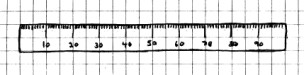
Examine the meter stick you are
using carefully. You will notice that it is divided into
ten equal parts. Look for the longest dividing lines on
the meter stick. (There will be nine of them.)
Make marks on the wood strips at each of these lines, and
carefully draw in your own dividing lines at each of these
marks. Try to make the lines all the same length.
Each of the units you just marked is 1/10 of a meter.
1/10 of a meter is a ”decimeter.” The prefix “deci-”
means 1/10, so there are ten decimeters in a meter.
Count them.
Now look at one decimeter on your meter stick. Notice
that each decimeter is also divided into ten equal
parts. Each of these parts is called a
“centimeter”. A meter is divided into a hundred
decimeters, so each centimeter is 1/100 of a meter. The
prefix “centi-” means 1/100. It will take a little
while, but mark off the centimeters on your meter stick.
The marks for each centimeter should be the same length, and
these marks should be shorter than the decimeter marks.
Also note that there will be nine of these marks between the
decimeter marks.
Take one more look at the meter stick. Look for the
shortest dividing lines. These small lines divide the meter
stick into 1000 equal parts. Each part is 1/1000 of a
meter and we call each part a “millimeter”. The
prefix “milli-” means 1/1000.
You do not need to mark each millimeter on your stick, but you
can if you want to be able to measure more
accurately.
What Happened:
The trick to using a meter stick to measure shorter lengths is
dividing it into smaller units, and it really isn’t a trick at
all. The meter is divided by tens to get all of the
units we need to measure. These divided measurements are
identified by prefixes which tell you what part of a meter
they are. So far, you have learned three of the four you
will need to know - deci- (one tenth), centi-.(one hundredth),
and milli- (one thousandth). There is another bit of good news
about these prefixes. They are the same ones used
throughout metric system. You won’t have to learn a lot
more!
The meter stick described above may be
used to measure many lengths that you would normally use
feet or inches to measure. Measuring lengths in the
metric system is actually very easy, but it takes a little
practice.
.
Materials Needed:
Meter stick (the homemade meter stick described above
will work just fine); ruler; Post-it Notes ® (or
similar); a friend.
Procedure: Stand
up against a wall and have a friend hold a ruler over your
head to mark your height. Mark this spot on the wall
with a Post-it paper. Now mark your friend’s height the
same way.
Using your meter stick, measure both your height and your
friend’s height in centimeters. If you aren’t sure how to use
the meter stick to measure centimeters, you may want to ask an
older student or teacher to help you.
What To Look For:
In countries that use the metric system, a person’s height is
generally measured in centimeters. Many lengths shorter than a
meter are measured in centimeters as well.
What Happened:
Depending on how tall you are, your height is probably
somewhere between 100 and 200 centimeters. The
centimeter is a convenient unit for things you would normally
measure in inches. You may have wondered why the decimeter
isn’t used. It could be, but for most lengths,
centimeters are used instead.
Going Further: Once
you understand how to measure in centimeters, you should
practice measuring different objects around your home or
classroom until you’re sure you know how to do it.
Centimeters are fine for measuring most lengths up
to a few meters, but if we want to measure smaller objects,
and measure them accurately, we need to use those little
tiny marks on the meter stick - the millimeters.
Materials Needed: A
ruler that is divided into metric units, or a meter stick;
several small objects to measure (each should be less than 6
inches long).
Procedure: Many
plastic and school rulers are divided into metric units as
well as inches. You probably have such a ruler in your house
or at school. If you examine it closely, you will notice
that the metric side is divided into centimeters, and that
each centimeter is further divided into ten equal parts.
Each of these parts is one millimeter. If you don’t have
such a ruler, you can always use a meter stick that is divided
into millimeters, although it may be a little harder to
handle.
Use the meter stick to measure the objects you selected in
millimeters.
What To Look For: The
millimeters will have marks but they won’t be numbered, so
you’ll have to remember that there are ten millimeters in a
centimeter. For example, if the object you’re measuring
is a little over five centimeters, to the five centimeter mark
will be fifty millimeters. Then you count the individual
marks from there to the end of your object and add that number
to fifty to get the total number of centimeters.
If you have trouble understanding this, get an older student
or teacher to show you how it is done.
What Happened: A six
inch object is almost 152 millimeters. You may have
wondered why we would want to use such tiny
measurements. The answer is simple. When measuring
small objects such as the ones you just did, the millimeter is
much more accurate than inches, and the good news is that you
don’t have to worry about all those different fractions of an
inch.
Going Further: Once
you understand how to measure in millimeters, continue to
practice measuring objects until you are confident you know
how to do it well.
You have seen how you can use the meter, decimeter,
centimeter, and millimeter to measure lengths. These
may easily replace yards, feet and inches. But what
about long distances measured in miles in the English
system? We can use the meter to measure those
distances, too.
Materials Needed:
Meter stick; (the homemade meter stick described
above will work just fine); calculator.
Procedure: This
experiment is really a “thought” experiment, because you are
going to do it in your mind. Look at your meter stick
again. Remember, it is a little longer than a
yard. A football field is 100 yards long, so if you were
to add a little bit to that length, it would be 100 meters
long.
Imagine a distance ten times as long as that football field
plus a little more. That would be 10 times 100
meters or 1000 meters. 1000 meters is is the
unit we use to measure longer distances in the metric
system. 1000 meters is called a “kilometer”. The
prefix “kilo-” is our fourth and final prefix, and it means
1000.
A kilometer is approximately equal to 3/5 (.6) mile, so you
can see it is just a little more than half as long as a
mile. Trying to think in terms of kilometers instead of
miles is probably the hardest part of working with metric
lengths, because, unlike the meter and the yard, the two
lengths aren’t all that similar.
The only way to “practice” using kilometers is to convert
familiar distances in miles to kilometers. To
convert miles to kilometers, multiply the miles by 3/5 (or
.6). Use a calculator, if necessary. Complete the
following table:
| Distance | Miles | Kilometers |
| Across the United States | 2,500 | ? |
| From the Earth to the Moon | 250,000 | ? |
| From the Earth to the Sun | 93,000,000 | ? |
| From your home to your school | ? | ? |
| From your home to _____ | ? | ? |
Going Further: Let’s review what you need to remember about
measuring length in the metric system.
1. It’s all based on the meter.
2. A meter is just a little longer than a yard.
3. All the other units we need are made by dividing or
multiplying the meter by tens.
4. The other units are identified by adding
prefixes. The “big four” are: